

First published January 22, 2026 | https://doi.org/10.1111/mms.70129
AUTHORS
Joel A. Arredondo-Sáinz
Centro de Investigación Científica y de Educación Superior de Ensenada
Mario A. Pardo
Centro de Investigación Científica y de Educación Superior de Ensenada
Héctor Pérez-Puig
Prescott College Kino Bay Center for Cultural and Ecological Studies
Gisela Heckel
Centro de Investigación Científica y de Educación Superior de Ensenada
ABSTRACT
The fin whales (Balaenoptera physalus) in the Gulf of California comprise a resident population genetically isolated from the rest of the North Pacific. The species occurs in the Eastern Midriff Islands Region (EMIR), in the central Gulf of California. The present study estimated fin whale abundance and apparent survival using photo-identification data collected via weekly small-boat surveys conducted from 2009 to 2017.
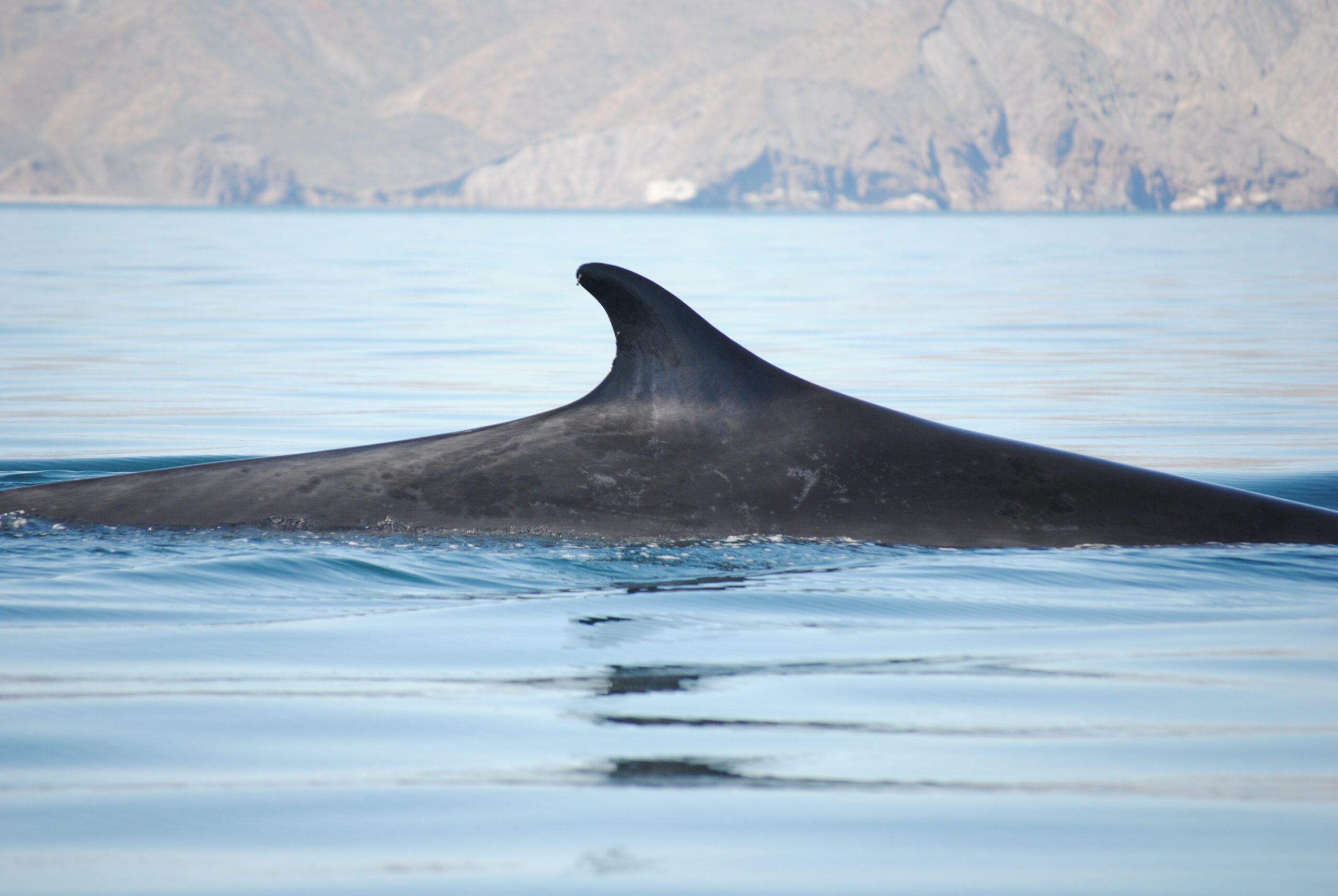
In total, 1082 fin whales were recorded during 287 surveys that totaled 1924 h of research effort. After a photo comparison process of the dorsal fin, 376 unique individuals were identified, of which 180 had distinct features and high-quality photos to be included in the mark-recapture analysis. A mark ratio of 0.615 was obtained. A Jolly–Seber/POPAN mark-recapture model yielded a superpopulation size of = 360 (SEUn = 34.4, 95% CI [304–429]). The estimates for the years 2010–2016 were similar, from 178 (95% CI [185–363]) to 259 (95% CI [179–375]). A Cormack-Jolly-Seber model was used to estimate probability of survival. A hierarchical Bayesian time series analysis of encounter rates collected from 2012 to 2017 showed evidence of seasonality, with whales mostly present during the cold season (December–May), which coincides with the local upwelling regime. This information adds to the value of the EMIR as an important area for fin whale conservation in the Gulf of California.